Ebook Download The Confidence Game: Why We Fall for It . . . Every Time, by Maria Konnikova
Currently, just what do you think of the arising books this moment? A lot of books are presented and released by many publishers, from several nations in this world. However, have you to be much more discerning to choose among the very best. If you are puzzled on exactly how you choose guide, you could draw from the topic to offer, the writer, and also the referral.
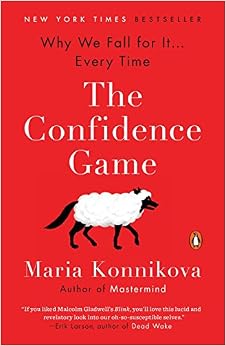
The Confidence Game: Why We Fall for It . . . Every Time, by Maria Konnikova

Ebook Download The Confidence Game: Why We Fall for It . . . Every Time, by Maria Konnikova
Lots of people are attempting to be smarter on a daily basis. Just how's regarding you? There are lots of methods to evoke this case; you can discover understanding as well as lesson anywhere you want. Nevertheless, it will involve you to obtain just what telephone call as the favored point. When you require this sort of sources, the following publication can be an excellent choice. The Confidence Game: Why We Fall For It . . . Every Time, By Maria Konnikova is the title of guide,
Well, now allow's see just how guide will certainly exist for you. The Confidence Game: Why We Fall For It . . . Every Time, By Maria Konnikova is the one that can influence you to have much better time to relax. So, what you get in the spare time is not only relaxing yet likewise more knowledge. Understanding and experience are very worthy and also they will be timeless. The existence of this publication could sustain you to have that ageless well worth. Very precious and important are what you can also acquire from reading this publication.
No, we will share you some inspirations about exactly how this The Confidence Game: Why We Fall For It . . . Every Time, By Maria Konnikova is referred. As one of the reading publication, it's clear that this book will certainly be definitely done considerably. The related subject as you require currently becomes the man element why you should take this book. Additionally, getting this publication as one of reading products will certainly enhance you to get even more information. As understood, even more info you will certainly obtain, much more upgraded you will certainly be.
Yeah, the material of this book features easy words, simple language styles, as well as very easy feeling to understand. When you have found this suggested publication to check out, one to do is only by inspecting it in the web link as well as get it. You should start immediately since there are also many people that have actually got and also checked out The Confidence Game: Why We Fall For It . . . Every Time, By Maria Konnikova So, you will not be left back to know even more regarding this publication material.
"It’s a startling and disconcerting read that should make you think twice every time a friend of a friend offers you the opportunity of a lifetime.”—Erik Larson, #1 New York Times bestselling author of Dead Wake and bestselling author of Devil in the White CityThink you can’t get conned? Think again. The New York Times bestselling author of Mastermind: How to Think Like Sherlock Holmes explains how to spot the con before they spot you.“[An] excellent study of Con Artists, stories & the human need to believe” –Neil Gaiman, via Twitter A compelling investigation into the minds, motives, and methods of con artists—and the people who fall for their cons over and over again. While cheats and swindlers may be a dime a dozen, true conmen—the Bernie Madoffs, the Jim Bakkers, the Lance Armstrongs—are elegant, outsized personalities, artists of persuasion and exploiters of trust. How do they do it? Why are they successful? And what keeps us falling for it, over and over again? These are the questions that journalist and psychologist Maria Konnikova tackles in her mesmerizing new book. From multimillion-dollar Ponzi schemes to small-time frauds, Konnikova pulls together a selection of fascinating stories to demonstrate what all cons share in common, drawing on scientific, dramatic, and psychological perspectives. Insightful and gripping, the book brings readers into the world of the con, examining the relationship between artist and victim. The Confidence Game asks not only why we believe con artists, but also examines the very act of believing and how our sense of truth can be manipulated by those around us.
Your recently viewed items and featured recommendations
›
View or edit your browsing history
After viewing product detail pages, look here to find an easy way to navigate back to pages you are interested in.
Product details
Paperback: 352 pages
Publisher: Penguin Books; Reprint edition (January 10, 2017)
Language: English
ISBN-10: 0143109871
ISBN-13: 978-0143109877
Product Dimensions:
5.5 x 0.7 x 8.3 inches
Shipping Weight: 9.6 ounces (View shipping rates and policies)
Average Customer Review:
4.0 out of 5 stars
200 customer reviews
Amazon Best Sellers Rank:
#23,245 in Books (See Top 100 in Books)
I purchased this book with high hopes. I've read the prologue (which you must read or else you won't understand parts of Chapter 1) and Chapter 1 and I won't be reading a lot more. This book deals with con men (and women) and the author has an interest in topics like personality theory and the dark triad. But the treatment lacks any sort of integration and comes across as more of a data dump than a smooth narrative. For example, perhaps a dozen times in Chapter 1, the narrative will end with a section break and pick up again about something entirely new without any sort of attempt to create a transition or draw a conclusion. The conclusions and assertions that are present, don't seem particularly insightful and are sometimes contradictory. Also, she doesn't cite the psychological work that she is using, so identifying the original source can be impossible (it's not clear, but at least in some cases this many be because she interviewed the researcher and they made reference to a study).So, to close a fairly negative review on a positive note: The stories she tells about cons and marks are mostly interesting. The book is worth three stars on that basis and if that's all you wanted from the book, it might be quite enjoyable for you.
Konnikova promises a lot in the titles to her books. I read Mastermind: How to Think Like Sherlock Holmes and was disappointed. I did not learn to think like Sherlock Holmes; not by a long shot. In this book, Konnikova has come closer to delivering the "Why We Fall for It . . . Every Time" but I disagree with her observations and conclusions. As a former prosecutor of elder abuse crimes (both physical and financial), I have a lot of experience with people who "fall for it." But that certainly doesn't mean everyone does. Nor does it mean that the ones who don't "fall for it" are more cynical, less humane, less open to true friendship, etc. In fact, Konnikova's description of victims of con artists as being more open and in touch with their humanity sounds like the manipulation of a con artist. Not that I think Konnikova is a con artist. She is just a very ambitious young woman and a self-promoter. I have read a lot of her magazine articles and have enjoyed many of them. Unfortunately, her organizational and analytical skills as a writer do not make her a good writer of books. Viewed as a series of magazine articles with the inevitable repetitions this book holds up fairly well. But as a book, it lacks a great deal. It certainly deserves 3 stars, but its failure to respond to bigger questions with bigger answers makes it fall short. For me, it was an uneven, often repetitious, fairly shallow approach to a fascinating subject. Until she matures as a thinker and researcher, Konnikova does better when she sticks to the magazine articles that she handles so well.
the author's being a psychologist with first rate credentials as psychologist certainly makes the case studies interesting and her insight all the more intriguing. What I didn't particularly like(or rather I should what really didn't resonate with)was the really exhaustive degree in which she explores the topic often needlessly repeating or rehashing material that was covered before. She could quite conceivably condense about half of it and I and perhaps other readers wouldn't feel so bogged down by what comes across as a microscopic exploration characteristic of a lengthy ph d thesis on the topic of confidence games. In this sense, the in depth treatise would genuinely qualify as a lengthy magazine article in for example, the L.A. Times Sunday edition supplemental magazine, same thing with the N.Y. Times.
Konnikov, aside from having the PERFECT name to tackle this topic, is a talented writer. She is conversational without being too present (in that creepy, uncle-at-your-bedroom-window kind of way) and knowledgeable about the history of cons and cognitive science behind how they work and why we fall for them. She tackles the fascinating subject with the perfect blend of engaging writing, rigorous research and guilty appreciation for con men (and they are almost all men, apparently) and their devious trade.She uses plenty of historic examples of memorable and lucrative cons, as well as some painfully recent examples (Madoff, for example), strategically stretching them out across chapters to make this a borderline page-turner, as I always wanted to find out how badly the marks would be taken and if the cons ever got their comeuppance. I also appreciated the thought that went into the overall structure (the sure sign of a writer who understand the psychology of storytelling), organizing the chapters around the components of a big con — the put-up, the rope, the send, etc. — which is a great way to seed the lingo and reinforce just how complicated a con is and just how much they rely on instinctive (or learned) understanding of deep psychological concepts.Cons can only work because we humans are, mostly, wired to trust. “We are so bad at spotting deception because it’s better for us to more trusting. Trust, and not adeptness at spotting deception is the most beneficial path.†For such social, collaborative creatures, trust is vitally important to work together. And cons take advantage of that.Cons, it seems, are wired a little differently than most, often scoring high on the “dark triad†of personality traits: narcissism, Machiavellianism and psychopathy. That leaves them self-interested and joyously amoral. Luckily, evolution has seen to it that those who possess those and other maladaptive traits ever only exist in relatively small numbers, or else risk dragging the whole species down into oblivion. “Calculated nonchalance [regarding moral imperatives] is only an adaptive strategy when it’s a minority one.†Otherwise, we’d all be so busy fleecing each other and exacting revenge, the human race might just flicker out.So, along with exploitable trust, add in greed, an overwhelming desire to feel special and a few other psychological traits like “egocentric anchoring†(“We assume that other know what we know, believe what we believe, and like what we like.â€) and “the mere exposure effect†(familiarity breeds affection), and the stage is set for being suckered.The part that resonated the most with me is how victims of cons often fall for a scam because of a shared predilection of all humans — our love of stories. Our brains are wired to receive information in story form, and cons are really just an elaborate, and expensive, form of story-telling that puts the victim in the center of a new and interesting universe where it makes perfect sense that they can get money for nothing or that they are of the blood line of an ancient religious order and must liquidate their resources to go on the run. It’s exciting! People want to feel special, and stories about them are the best ways to make that happen, lowering defenses and loosening purse strings in the process.And we especially love a good story that resonates with our core beliefs. “Why form accurate judgments when the inaccurate one make our life far more pleasant and easy?†Easy because we don’t have to challenge our long held assumptions (such as the fact that we really are special). The comforting story soothes away the cognitive dissonance because, “when a fact is plausible, we still need to test it. When a story is plausible, we often assume it’s true.â€And cons often invoke “information priming†which exploits “the ease that comes from familiarity. Mention something in passing, and when you elaborate on it later – especially if it’s a few days later – it seems that much more convincing. It’s a phenomenon known as the illusion of truth: we are more likely to think something is true if it feels familiar.â€And that goes double if that something has emotional appeal. “Our emotional reactions are often our first. They are made naturally and instinctively, before we perform any sort of evidence-based evaluation.†In other words, “Con men … are likewise expert at rapidly involving greed, pity and other emotions that can eclipse deliberation and produce an override of normal behavioral restraints.â€Equal parts journalism and psychology, the end result is a riveting look at what it takes to convince people to, against all their better instincts, act against their own self-interest.
The Confidence Game: Why We Fall for It . . . Every Time, by Maria Konnikova PDF
The Confidence Game: Why We Fall for It . . . Every Time, by Maria Konnikova EPub
The Confidence Game: Why We Fall for It . . . Every Time, by Maria Konnikova Doc
The Confidence Game: Why We Fall for It . . . Every Time, by Maria Konnikova iBooks
The Confidence Game: Why We Fall for It . . . Every Time, by Maria Konnikova rtf
The Confidence Game: Why We Fall for It . . . Every Time, by Maria Konnikova Mobipocket
The Confidence Game: Why We Fall for It . . . Every Time, by Maria Konnikova Kindle